History of Ellesmere Green
by Bernadette Lamb
Last month’s feature (A
fond farewell) on Ken Clarke’s retirement, and proposals
that perhaps a market could be held, have focused attention
on what has come to be known locally as ‘Ellesmere Green’.
Contrary to what some recent arrivals believe, this is not
the last vestige of some ancient village green; in fact in
historical terms the ‘Green’ is very modern indeed.
Until the beginning of the 19th Century the
area between the Wicker and the Toll Bar was occupied mainly
by orchards and market gardens. With the coming of the railway
and its station on the Wicker, industry began to spread into
the Don Valley and the suburb of Burngreave took shape in
1837 and Burngreave Road was built to give easier access to
the Turnpike Road at Pitsmoor. Residential terraces on Spital
Hill and villas on the new road began to be built, while the
lower slopes became covered in closely packed back-to-backs
to house the factory workers.
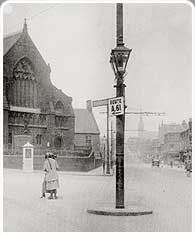
Congregational Church
The first big development came in 1855 when
the Wicker Congregational Church was built on the triangular
plot made by Burngreave and Ellesmere Roads and Gower Street.
The fine Gothic Church and Sunday Schools were a world away
from the humble origins in a room on the Wicker where premises
were shared with a midden and a performing bear.
The Vestry Hall
Changes in local government paved the way for
this area to become an important civic centre. In 1864 the
Vestry Hall was built to serve the Brightside Bierlow as offices
for the collection of rates and registry. The 1902 Directory
lists George H Wilkinson as “collector of the general
district rate” and Lawrence A Morley Registrar for “the
sub-district of West Brightside.” In its long life,
the Vestry Hall has been a venue for dances, election meetings,
wedding receptions and concerts. It has served as a Polling
Station, a Community Centre, Sports Hall and even in hard
times a soup kitchen besieged by bare foot children.
Brightside Library
In 1872 the area was further enlightened by
the opening of the (then) Brightside Library, the first purpose-built
library outside of the City Centre. Originally the books were
locked up and you had to choose from a catalogue. In the reading
room the newspapers were also chained. Older residents may
remember the spiral staircase which gave access to the staff
quarters. It was eagerly watched by local youths hoping for
a glimpse of a trim ankle! Some may also remember when newspapers
had the racing news blacked out to discourage gambling.
Commercial Centre
To complete the ‘official’ content
of the area, Burngreave enjoyed the services of two Police
Stations; the West Riding Constabulary at 9–11 Burngreave
Road and the City Police at number 24. This was a thriving
shopping centre where every conceivable want could be satisfied.
I don’t know if there is a connection between the eight
butcher’s shops and the seven surgeons in the area,
but all were doubtless busy. The number of shops grew in line
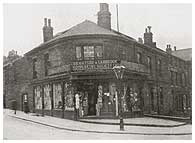
with housing development, culminating in the opening of the
Brightside and Carbrook Co-op on the corner of Gower Street
and Grimesthorpe Road. It had the lot – butchers, grocers,
drapery, ladies and children’s wear. Gower Street was
much narrower then; the old Wicker Congs’ towered over
the surrounding buildings: the famous Nan Wong Chinese Laundry
next to the Library, Burgon’s grocers and Matlock’s
butchers, where old Fred Matlock was still working at 82 and
remembered taking the meat out on a sledge in the terrible
Winter of 1947.
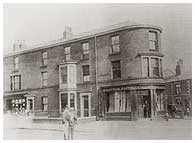
On Ellesmere Road, Ken Clarke’s original
‘Corner news’ was a tiny wedge shape building.
The more modern aspect of his present shop (formerly the Bendix
Laundrette) can be attributed to a World War II bomb. Next
door was Walter Wild’s fish shop. With no shop front
all the fish was laid out on a huge marble slab. Going the
other way was Hymans Household Furnishers, Arthur’s
Butchers, Myers Bakers, Middletons Hardware, The Post Office
(still thankfully with us) and TSB. The picture is rounded
off with John Heath (serving the community for over a hundred
years), the shell of the old Albion public house and, at the
top of Hallcarr Street, was Bailey’s the old fashioned
grocers where they sliced your bacon exactly to your liking.
In 1970 the ‘Wicker Congs’ came
down in a cloud of dust, the processions for Whit Sings are
no more and the Boys Brigade Band is silent. And in its place
is the Green.
While The Vestry Hall perilously awaits a re-invention, should
we ask; “Where do we go from here?”
|