Wicker
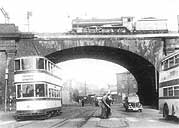
- All Change! Phase 2 of the Inner Ring Road now seems set to get the go ahead, the result will include the loss of many of the buildings between the Wicker Arches and Shalesmoor. Here we look at the railway that brought the outside world to the Wicker. Because of the gradients around Sheffield, in the early days of steam Sheffield was bypassed, the nearest station on the Midland Railway was Rotherham. Our first Railway Station was the Midland Station, at the junction of Savile Street and Spital Hill, opened in October 1838, now only to be recognised by its plaque, the gate posts from a later period, when it was a Railway Goods Yard, and a modern stainless steel sculpture; ‘Made in Sheffield’ by Amanda King. It was not until 1870 that the present Midland Station was opened to accommodate direct trains to London. Between these two dates, the Manchester, Sheffield and Lincolnshire Railway made plans to construct the Woodhead Line between Manchester and Sheffield. In those days the prominent railway engineers, responsible for the steaming through of the railways were George Stevenson, inventor of The Rocket, and Isambard Kingdom Brunel. The Woodhead line however was to be entrusted to two relatively unknown Sheffield born engineers, Joseph Locke (later to becomeSir Joseph Locke, MP for Honiton and claimed by Barnsley as being theirs) and John Fowler (later Sir John Fowler, Bart.) Joseph Locke was born on August 9th 1805, on Attercliffe Common. The family moved to Barnsley when Joseph was five, later Locke was introduced to George Stevenson by his father and went to work for him. He became the engineer for the 42-mile Manchester to Bridgehouses line and for the three-mile Woodhead Tunnel, opened on December 23rd 1845. The station at Bridgehouses was quickly outgrown and an extension of the line to a new Victoria Station was planned. The engineer for this was John Fowler, of Wadsley Hall born 15th July 1817. A 750-yard viaduct, its arches forty feet above the Wicker was built to link the two stations during 1847–8, it incorporated a lift from the roadside to the station above. John Fowler had a career in railways which peeked with his construction, with fellow engineer (Sir) Benjamin Baker, of the Forth Railway Bridge in 1890. The Wicker arches were damaged by a bomb during the blitz of December 1940. The line was electrified in the 1950s only to be closed for passenger services in 1970. Burngreave Historical Society have discussed the proposed Phase 2 of the Inner Ring Road with Sheffield City Council and are convinced that their plans include suitable safeguards to protect the heritage of the area. The Wicker and Spital Hill will feature in future articles by the Burngreave Historical Society.
|
|