Junior School Results Announced
 This
year's provisional SATs results for children finishing Primary school
show a mixed bag for Burngreave Schools.
This
year's provisional SATs results for children finishing Primary school
show a mixed bag for Burngreave Schools.
While the number of children making the grade in English and Maths rose at Firshill and Pye Bank Junior schools, results at other Burngreave Junior and Primary schools were less good.
At Firshill Junior School two-thirds of the Year 6 children achieved the level 4 national standard. The boys did even better than the girls, with 73% achieving the grade. This is higher than national figures and bucks the national trend where boys lag behind.
While many still question the tests as a narrow way of measuring children's achievement, results do seem to show that more needs to be done to make sure children in the area achieve the national standard in English and Maths.
While figures may rise following appeal, it looks as though only about half of Burngreave 11 year olds tested at the national standard in English, while only a third of children achieved level 4 in Maths.
Fir Vale School recently announced a rise in the number of children achieving 5 or more GCSEs from 11 to 17%. The school recently had a visit from education minister David Blunkett, who is to give £400 000 extra cash to each Fresh Start school. Fir Vale will use the cash to give staff a 5% loyalty bonus.
 £5000
Grants for Education Projects
£5000
Grants for Education Projects
Grants of up to £5000 are to be available soon from the SRB4 Education Consortium. The following activities can be funded:
-
Feasibility studies leading to further projects in education.
-
New or enhanced out-of-school activities that would help improve attainment of school children.
-
New or enhanced lifelong learning projects.
-
Start-up costs for projects that would deliver any of the above activities.
Permaculture is a practical concept which can be applied in the city, on the farm, and in the wild. Its' principles empower people to establish highly productive environments providing for food, energy, shelter, and other material and non-material needs, including economic.
Permaculture adopts techniques and principles from ecology, appropriate technology, sustainable agriculture, and the wisdom of indigenous peoples. The ethical basis of permaculture is seated upon care of the earth, where all life can thrive.
It is urban as well as rural community planning, design and development, but also includes, the use of appropriate technologies (coupled with an adjustment of lifestyle) and adoption of ideas that are both earth-based and people-centered.
This includes human access to resources, but not the accumulation of wealth, power, or land beyond their needs.
 Burngreave
Frontline
Burngreave
Frontline
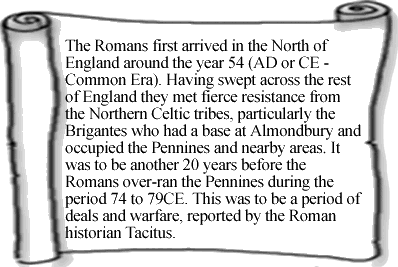
Roman Times?
"Queen Cartimandua, ruler of the Brigantes, had the power and influence that belongs to high birth. Her reputation grew when she captured King Caracatacus by treachery - another feather in the cap for that triumphant Claudius Caeser. From this came her wealth and the wanton spirit which success breeds. She grew to despise her husband Venutius and took his personal servant Vellocatus as her lover and to share the throne. Her clan was shaken by the terrible scandal. The citizens sided with her husband, but the adulterer was supported by the queen's passion for him and by her savage spirit.
So when Venutius called in help from outside, just as the Brigantes
were in revolt, Cartimandua was put in an extremely dangerous position.
It took several battles before the Roman cavalry and infantry companies
finally succeeded in rescuing the Queen from danger. The throne was
left to Venutius; the war to us."
Histories of Tacitus, Book III, XLV,
new translation from latin for the Messenger:Amanda Gibson
We should perhaps be a bit cautious with the words of Tacitus - he was after all the historian for the winning side. He was clearly somewhat shocked by the warmaking and amorous antics of the Celtic warrior queens like Cartimandua, as is also shown by his references to Boudicca, the Celtic Queen who gave the Romans such trouble the year 60 C.E.
 Cartimandua
- Matriarch or Traitor?
Cartimandua
- Matriarch or Traitor?
The Brigantes name shows they were the "people of Bridget" - a goddess cult popular with Celts from Cornwall to Orkney. It has been suggested that Cartimandua was part of a female royal line who chose temporary partners who played the role of King, but were then sacrificed at which point another partner was taken on.
Clearly having the Roman empire on the doorstep had produced tensions in the tribe. Cartimandua's betrayal of the Welsh Celtic leader Caracatacus won't have endeared her, and in this context any suggestion that a war-leader like Venutius be sacrificed would have been less than popular.
Either way though, it seems that some combination of Cartimandua's deals with the Romans and Venutius' war strategy kept the Romans out of most of what is now Yorkshire for over 20 years.
Roman Fort
It is thought almost certain that the Roman fort at Templeborough dates from this period where the Brigantes stalled the Romans. It seems likely therefore that they were somehow connected with the Brigantian politics referred to by Tacitus. The fort is now under the Templeborough Steel Works the other side of Meadowhall.
Roman Ridge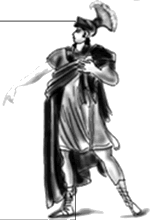
More difficult to date is the Roman Rig or Ridge - a bank that runs from Pitsmoor to Mexborough. Little of this now remains in Pitsmoor, though it is thought to have run from Close to the Wicker, up and along Grimesthorpe Road, where it was still possible to trace in the 1930s. The Ridge then ran below the Cetic fort on Wincobank, through Wincobank, where it is still visible, then away through the Meadowhall roundabout to Rotherham. The sections from Rotherham to Mexborough go through undeveloped countryside and can be walked today.
Brigantian Defence
There is not enough evidence to know for certain the reason the Ridge was built but its position in the geography strongly suggests a defensive purpose. The hillfort at Wincobank may have been an outer defence of the Brigantian base at Almondbury. Mexborough would also have provided a good point to defend as it would have been mostly surrounded by marshland. The camp at Roe Wood may have formed part of such a defensive structure.
Frontline
Did the Ridge form the front line between the Brigantes of Cartimandua and Venutius and the Romans based at Templeborough? It may have been built earlier to defend against another Celtic tribe - the Belgae. It seems certain however that Burngreave was close to the heart of the conflict brought about by the Roman Invasion.
Research: Ian Clifford, Steve Cooke
 |
|
|
|
|
|
|
|
|
|
|
|
|
|
 |
|
||||||||||||
 |
 |
 |
|
||||||||||
 |
|
||||||||||||
 |
 |
 |
|
||||||||||
 |
|
||||||||||||
 |
 |
 |
|
||||||||||
 |
|
||||||||||||
 |
 |
 |
|
||||||||||
 |
|
||||||||||||
 |
 |
 |
|
||||||||||
 |
|
||||||||||||
 |
 |
 |
|
||||||||||
 |
|
||||||||||||