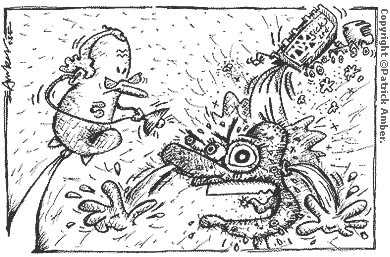
 "I
think this is more than a common cold,
doctor..."
"I
think this is more than a common cold,
doctor..." |
For the study, the surrounding area was separated into four
zones, each a kilometre wide, radiating up to four kilometres
from the landfill site. Burngreave lies mostly in zone 2.
Within one kilometre of the site (zone 1), reported levels
of bronchitis are more than twice those for Sheffield as a
whole. Levels of chronic obstructed airways disease (COAD)
are two and a half times higher.
Bias ruled out?
Such results seem to point to the landfill site as the source
of these problems. But Dr Jeremy Wight, Director of Public
Health at North Sheffield Primary Care Trust (NPCT), who commissioned
the study, provides two other possible explanations: other
environmental causes of the symptoms, and what the study terms
'reporting bias' – that the rise in self-reported symptoms
was caused by heightened awareness in the community (as described
in our main story: Fury over
Parkwood Health Study).
As a result, the NPCT cannot confirm any connection between
the site and local health problems, and proposes further research
which would take another year.
But the study itself offers several reasons why the 'reporting
bias' explanation is unlikely. One is the distinct difference
in levels of symptoms reported in study zones 1 and 2. For
example, bronchitis symptoms are reported at twice the level
in zone 1 than they are in zone 2. "It would be odd if
reporting bias were to affect [people in zone 2] substantially
less than people living in the innermost zone," comments
the report.
Some symptoms are reported less in zone 1 than further away.
People living further from the site reported more symptoms
of liver disease than those close to the site. If there was
no reporting bias for these symptoms, then why assume there
is reporting bias for the others?
Finally, the reporting pattern for bronchitis and COAD symptoms
is supported by the results of a previous survey (see Top
of the Coughs issue 17, November 2001).
In addition, the survey questionnaire was designed to take
account of, and reduce, the possibility of recording bias.
I put it to Dr Wight that these arguments effectively ruled
out the 'reporting bias' explanation. He told me that the
study does not rule out this explanation, and that I would
be wrong to report that it did. Brian Wilson, long-time campaigner
for the site’s closure described reporting bias as "a
polite way of saying victims are lying."
No intention to prove anything
We were told in February that a survey was "to be carried
out to see if the site is damaging health" (Study
examines landfill effects on health issue
29, March 2003). Now it appears that the survey results
could never prove anything because of the possibility of ‘reporting
bias’. It is not surprising that local people feel betrayed.
They completed questionnaires in good faith and are now told
that their answers cannot be believed. Instead they are told
to wait for further studies by experts, while the evidence
in the Report appears to confirm what their daily experience
tells them: their health is in danger.
Do landfill sites cause ill health?
Part of the Report consists of a review conducted by the
Chemical Incident Response Service of previous studies into
links between landfill sites and adverse affects on the health
of local residents.
The review said studies were inconclusive. However the Messenger
is aware of various studies which strongly indicate links:
In Hamilton, Ontario, a study of people who lived and/or worked
near an industrial dump revealed significantly elevated rates
of bronchitis, breathing difficulties, coughs, skin rashes,
arthritis, heart problems (angina and heart attacks), muscle
weakness, tremors, cramps, headaches, dizziness, lethargy,
balance problems and mood symptoms, compared with populations
living further from the site (Hertzman, C. et al., "Upper
Ottawa Street Landfill Site Health Study," Environmental
Health Perspectives, vol. 75, 1987, pp 173-195).
An American study of 7 waste disposal sites showed increased
incidence of dermatitis, respiratory irritation, neurologic
symptoms and pancreatic cancer in nearby populations (Barry
L. Johnson, Asst. Surgeon General, testimony before the Subcommittee
on Superfund, Recycling, and Solid Waste Management, US Senate,
May 6, 1993, citing various studies).
In Lowell, Massacchusetts, a group of 1049 people living
1200 feet from a chemical waste dump reported more complaints
of wheezing, shortness of breath, coughs, persistent colds,
irregular heartbeats, constant fatigue and bowel dysfunction,
compared to people living 2 and 3 times as far from the dump.
The study examined the possibility of recall bias and concluded
that this did not explain the findings (Ozonoff et al.,
"Health Problems Reported by Residents of a Neighborhood
Contaminated by a Hazardous Waste Facility," American
Journal of Industrial Medicine, vol. 11, 1987, pp 581-597).
Of course, we don’t know whether what was dumped at
these sites was similar to what is dumped at Parkwood, because
we are not told precisely what is being dumped at Parkwood.
The study ignores the analysis of dust from houses near the
site in October 2001 which showed the presence of cadmium
and arsenic, which can cause lung damage and sore throats
at low levels (Dumped
on us - everyone’s toxic waste issue 19, February
2002). Cadmium is present in the incinerator fly
ash dumped at Parkwood, brought from Edmonton, north London.
This appears to indicate a direct connection between the site
and reported symptoms.
As the Report was released, Viridor Waste Management, the
site’s owners and operators, issued a statement quoting
the Report’s conclusion that there are ‘no firm
grounds’ to conclude that the health of those living
near the site is affected by it. Viridor bought Parkwood landfill
for £20.6 million earlier this year.
What happens next?
Parkwood Landfill Action Group has called for an immediate
stop to toxic waste dumping. In response, Sheffield City Council’s
Cross Party Working Group on Parkwood Landfill (which reconvened
on 20 November) asked the Environment Agency to process the
re-licensing of the site as quickly as possible, so that toxic
waste dumping could be banned.
The NPCT is to examine local doctors' records to see if symptoms
reported in the study match up with people's medical records.
If they do, this will rule out reporting bias.
Local residents say other factors, such as wind and geography,
should have been taken into account in the study. Dr Wight
told the Council’s Working Group that further research
will analyse these factors and the study data will be re-analysed
in the light of them.
Closing the site
Only the Environment Agency can order Viridor to close the
site. The Messenger put it to Agency representatives
that the NPCT’s further research might well rule out
reporting bias and analysis of wind and geographical data
might reinforce the results of the study. In that case, would
they order the closure of the site? They responded only that
they would take further advice in response to such findings.
Only if it were proved that substances coming off the site
were actually causing diseases would the Agency close the
site. I asked them whether any kind of statistical data would
ever be sufficient to convince them that the site should be
closed. Again, they said only that they would take further
advice in response to such findings.
Agency representatives told the Council’s Working Group
that they could only close the site if it was proved beyond
reasonable doubt that it was damaging people’s health.
But Councillor Martin Davis pointed out that the law requires
the Agency to act if a site is 'likely to cause' injury to
health.
Analysis
Dr Wight continues to reassure critics that North Sheffield
PCT will not hesitate to seek the closure of the landfill
operation should any link between it and the ill health of
local residents be scientifically proven. Neither I nor anyone
else who is critical of the work and presentation of the Health
Impact Assessment Survey doubt the sincerity of this commitment.
The problem is that such agencies of the State cannot accept
what ordinary people say about themselves as scientifically
valid.
Dr Wight tells us that ordinary people who filled in the
survey questionnaire did so honestly, but their answers may
have been influenced by thoughts of which they were not aware,
because ordinary people don’t consider carefully whether
the answers they give are really true. Self-reported data
can only ever be regarded as indicating that a problem might
exist.
Once the existence of the problem has been established, scientific
truth may then be found by looking behind the apparent superficial
problem of self-reported symptoms for evidence that only experts
can find and interpret. This is the normal way in which scientific
knowledge is constructed by agencies of the State, and Dr
Wight and the PCT cannot proceed in any other fashion, because
of their institutional position.
But can the planned further scientific investigations deliver
the certainty we need? In practice, science rarely gives us
definite answers. It only provides probabilities. If GPs’
records confirm that there was no reporting bias in the study,
and meteorological studies and geographical studies show that
symptoms occur downwind of the site, then the probability
that pollution from the site is the cause of the symptoms
will have increased. But probability is all we will get.
In the absence of scientific certainty, the landfill operators
will continue to assert that nothing has been proved against
the site and the way it is operated.
Over the last few years the Messenger has heard
numerous reports from those who live close to Parkwood that
there are times when they children cannot play outside their
homes, because of dust and smells which choke them and irritate
their airways. They feel ill. They report clear signs of effects
on their health. They observe that the dust and smell is carried
on winds crossing the landfill site. Their conclusions are
clear and logical, because they are based on the observed
relationship between a number of events that they experience.
It can be said that, in Shirecliffe and adjacent areas, it
is common knowledge that the site affects the health of people
living near it. But the knowledge of the State is opposed
to common knowledge, and by default supports the private company
that operates the site.
While the uncertainties of environmental science are posed
as a superior form of knowledge to logical conclusions drawn
from the experience of ordinary people, no precautions will
be taken to protect the health of those living near the landfill
site.
The full Health Impact Assessment Survey Report will be made
available on the Sheffield NHS website at www.sheffield.nhs.uk.
|










