




The Inspector
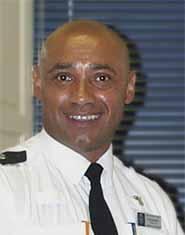
meets the Messenger Born in 1959 here in Sheffield, the man now sat beside me was not only black like myself but someone who’d grown up around the rough streets an underclass society of this inner city. “As a child I was bought up around Havelock Square,” said Inspector Jon Ekwubiri, “I have a younger brother and two younger sisters, our mother left when we were very young,” Jon continued relaying parts of his childhood that reflected a rough edge of society that I could also relate to. We both agreed that through the late fifties to early seventies many Jamaican and African, English born children suffered abhorrent upbringings. “My father was also very unsupportive, I guess he was also a bully,” I began to wonder if Jon knew just how many other stories I’d heard of tough parenting through this same era, surely caused by the frustration of suppression and unchallenged racism, suffered by our parents and grandparents. Attending High Storrs school in the early 70s Jon recalls there not being many black children and the racism he encountered. I’d already begun to see past the uniform of the man in front of me as someone who’d once been a boy, recollecting his life’s passage. “In 1982 I graduated from Sheffield Poly and studied electronic engineering, but couldn’t find a job here. I also realised, Rob, just how unrepresented black people were in the Police Force, so in 1983 I joined.” Handing Inspector Jon a coffee I sat opposite him wanting to know more about what inspired him to join the force which must have been yet another rough passage. One of his first experiences in uniform was having a front door shut in his face after a demand to be seen by a proper policeman! “Do you think there’s a cultural reason why you’ve been placed to work here in Burngreave?” I enquired. “No I don’t think so Rob. I was actually excited at the prospect and really feel people here get a raw deal. I believe Burngreave contains a majority of honest people and all they want is a fair deal from the system.” Jon’s had twenty years with the Police force, and goes on to talk about the racism he encountered as a recruit and how he put up with it until he made Sergeant in 1991. He then sensed attitudes changing towards his skin colour. He became an Inspector in 1997 and as a mentor he talks to others about tackling racism, although nowadays finds himself dealing more with sexism within the realms of South Yorkshire Police. “What is your opinion of our BNDfC funding a Police team Inspector?” “Well, there’s always room for improvement in whatever we are doing, Rob.” Being a non-smoker himself Inspector Jon had some personal opinions on our present drugs scene and crime culture. “In a few years, I can see the legalisation of cannabis and it won’t be an arrestable offence, unless violent behaviour leads to the obstruction of us carrying out our duties. But we have a different problem concerning class A drugs, as I’m sure you’re aware, and I personally have family members who’ve been affected by this.” “How do you see the way forward in dealing with the class A distribution said to affect this area?” “I see a need for more intelligence-led information here Rob, also showing the friendly face of modern day policing. I want to see beat officers talking to people and breaking down some of those barriers. Modern day surveillance and CCTV networks make monitoring and collecting intelligence a lot easier.” “Do you believe this police force will ever reflect equally in its make up the full diversity of the communities it’s now policing?” “Home Office quotes say we’re on target, although still underrepresented, it is a lot different than when I first joined over twenty years ago.” “Are you aware that, with regard to the Michaela Hague tragedy, it has been reported to the Messenger that the Police have not responded to further calls alerting them to women being attacked? What is the overall Police attitude towards prostitution being allowed to flourish in this area and of course the safety of women who ply that trade?” “I believe it’s a multi-agency problem. A lot of these girls are dependent on class A drugs and in many cases poorly educated. Trying to eliminate the problem in many cases just displaces it Rob. We need more joint working practices with other social agencies out there.” As we concluded the interview I realised it’s more about tolerance and seeking a solution to many of society’s social problems. I can also see a greater need for more representation of our diverse communities in the police force, to sustain what is a fine balance between law and order. Thanking the Inspector I realised how nice it was to be on the other side of the interview. Interview between Rob Smith and Inspector Jon Ekwubiri on 17th July 2003.
|
 |


